 TaroraGet early access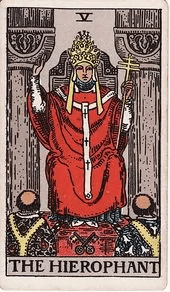
The Hierophant
Tarot Card Meaning
Upright
tradition, teaching, shared belief, guidance
Reversed
dogma, rebellion, questioning convention
The Hierophant sits between two pillars in a formal robe, a triple-tiered crown on his head, one hand raised in blessing. Two acolytes kneel before him. Two crossed keys rest at his feet. This is a card about the value of a shared framework, something learned from someone else rather than invented alone.
What does The Hierophant mean?
The Hierophant is tradition, teaching, shared belief, and guidance passed down through structures older than any one person. He's often read as the counterpart to The High Priestess's private, inner knowing. Where she trusts what's unseen, he trusts what's been tested and taught over time.
The two keys at his feet suggest access: knowledge that opens something, offered to those willing to learn it properly rather than skip ahead.
What does The Hierophant mean upright?
Upright, it looks like a class taught by someone who's actually done the thing, a manual you follow instead of guessing, a process you trust because it's been tested. It favors learning from people who've done this before you rather than reinventing it from scratch. There's real value in doing it the established way, at least for now.
He can also mark a mentor, a teacher, or a genuine desire to belong to something larger than yourself.
What does The Hierophant mean reversed?
Reversed, he tips toward dogma, rebellion, or questioning convention that's stopped making sense. A tradition being followed without asking why, or the opposite: pushing back hard against a structure that no longer fits. Either way, the relationship between you and the rule has become the real issue.
It can also mean outgrowing a teacher or an institution that once served you well but doesn't anymore.
What does The Hierophant mean in love?
In love, The Hierophant often marks a relationship shaped by shared values, a formal commitment, or family and tradition playing a real role. It favors doing things properly over improvising, the kind of bond built on something both people already agree matters.
Reversed, it can point to conforming to an expectation that doesn't actually fit the relationship, or breaking from convention on purpose.
What does The Hierophant mean in work?
At work, he can mean formal training, mentorship, or following an established process that genuinely works. Reversed, he can mean bureaucracy for its own sake, or a real need to challenge a rule that's outlived its purpose and is now just slowing everyone down for no good reason.
What does The Hierophant ask of you?
He asks whether the structure you're relying on still actually serves you, or whether you're following it out of habit. Tradition can be genuinely useful. The card's real question is whether you've actually checked, rather than assumed, the way you might have five or ten years ago.
A few reflection prompts, if this one's worth sitting with:
- What rule or tradition am I following without really questioning it?
- Is there a teacher or mentor I should be listening to more closely right now?
- Where have I outgrown a structure that used to fit?
FAQ
Is The Hierophant a religious card? It's often depicted in religious imagery, but its real meaning is broader: any shared belief system, institution, or established way of doing things.
What does The Hierophant mean for a decision? Usually that following an established, tested approach will serve you better than improvising.
Does The Hierophant reversed mean I should rebel? Sometimes, but it more often flags dogma or an outdated rule worth questioning rather than a call to reject structure entirely.
Who are the two acolytes kneeling before The Hierophant? They represent students or followers, showing the transmission of knowledge from teacher to learner that the card is built around.
If The Hierophant showed up in a reading of your own, Sophia can tell you whether the structure you're leaning on still fits your situation. Join the waitlist to be there when Tarora opens, or read how Tarora reads a spread in the meantime.