 TaroraGet early access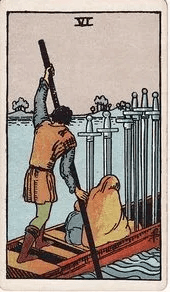
Six of Swords
Tarot Card Meaning
Upright
transition, leaving turbulence, passage to calmer water
Reversed
resisting change, unfinished business, stuck mid-crossing
A ferryman poles a boat carrying a woman and a child across calm water toward a distant shore, six swords standing upright in the boat behind them. The water they're leaving was rougher. The water ahead looks quieter. This is a card about genuine transition, moving through something rather than staying stuck in it.
What does the Six of Swords mean?
The Six of Swords means transition, leaving turbulence, and passage to calmer water, the specific feeling of actively moving away from a hard stretch toward something genuinely more settled. It's a card about real progress, even when it's quiet and unglamorous.
The upright swords matter: the difficulty isn't denied or left behind entirely, it travels along in the boat, but it's no longer steering the course.
What does the Six of Swords mean upright?
Upright, it points to a real move toward calmer circumstances, leaving a hard situation for something genuinely more stable, whether that's a place, a relationship, or a state of mind that's actually worth reaching for. The crossing takes real time.
It can also mark a literal transition, travel, relocation, or any real change of scene that puts distance between you and recent difficulty.
What does the Six of Swords mean reversed?
Reversed, it suggests resisting change, unfinished business, or being genuinely stuck mid-crossing, unable to fully leave the old situation or fully arrive at the new one waiting somewhere ahead. The boat has stalled somewhere in the middle, going nowhere for now.
It can also mean a transition that's technically happened but hasn't actually been emotionally completed, old turbulence still being carried forward.
What does the Six of Swords mean in love?
In love, the Six of Swords often marks a relationship moving through a real hard stretch toward calmer, more stable ground together, one honest step at a time, together rather than apart. It favors patience with the crossing itself, not just the destination.
Reversed, it can point to a relationship stuck between ending and continuing, neither fully left behind nor genuinely resolved.
What does the Six of Swords mean in work?
At work, it often signals a real transition, a new job, a role change, or a project moving past a genuinely difficult phase toward something calmer. Reversed, it can mean a change stalled halfway, or resistance to a shift that's actually necessary.
What does the Six of Swords ask of you?
It asks whether you're actually letting yourself move through this transition, or resisting a change that's already underway regardless. Calmer water is ahead. The card's real question is whether you're steering toward it or fighting the current the whole way there.
A few reflection prompts, if this one's worth sitting with:
- What real transition am I currently in the middle of, whether I've named it or not?
- Am I resisting a change that's actually already happening around me?
- What would it take to let this crossing finish instead of stalling halfway?
FAQ
Does the Six of Swords mean travel? It can point that direction, given the literal boat imagery, though more broadly it represents any real transition or move toward calmer ground.
Is the Six of Swords a good card to draw? Generally, yes. It suggests real, active movement away from a hard stretch, even if the crossing itself still takes time.
Why are the swords upright in the boat in the Six of Swords? They represent past difficulty being carried along rather than denied, present but no longer actively steering the direction of things.
Does the Six of Swords reversed mean I'm stuck forever? Not permanently. It more often points to a real stall mid-transition, something worth naming rather than a permanent state.
If the Six of Swords showed up in a reading of your own, Sophia can help you see what calmer ground might actually look like. Join the waitlist to be there when Tarora opens, or read how Tarora reads a spread in the meantime.